
Food Industry Conveyor Solutions: Matching Modular Mesh and Flat Belts to Hygiene Needs
On a food or beverage line, the conveyor belt is usually the last component specified and the first one blamed when a hygiene audit, a product-damage issue, or unplanned washdown downtime appears. Two belt families do most of the work in these plants: modular mesh chain belts and flat belts. From a distance they look interchangeable. In service they behave very differently.
This guide explains how to match each belt type to actual hygiene needs rather than to a catalogue price tag. It uses published model specifications throughout — including the PQ350mm±3mm modular chain belt with straight baffles for product handling and a PU flat belt range for clean, high-speed movement — and clarifies where each belongs.
What Food Buyers Are Actually Trying to Solve
Food-grade conveying is a hygiene-engineering problem before it becomes a mechanical one. Every hinge, gap, baffle root, and surface texture on a belt is a place where residue, moisture, or microbial growth can collect. A buyer evaluating a belt for a food line is answering three questions at the same time:
- Can the belt be cleaned to the standard the plant's food safety plan requires?
- Can it move the specific product without damage, spillage, or jams?
- Can it survive the cleaning method the plant actually uses — water, chemicals, heat, or a combination?
Belt selection goes wrong when only one of those questions is answered. A belt that cleans quickly but drops product on an incline creates rework. A belt that handles product perfectly but traps residue at the baffle root creates a compliance problem that surfaces at the next audit. The practical goal is not the single best belt — it is the belt whose structure matches the hygiene regime around it.
Industry Background: A Standards-Driven Category
Conveyor belting is a substantial global category, and food applications sit inside a market that is both large and heavily regulated. The global conveyor belt market was valued at USD 8.11 billion in 2024 and is projected to reach USD 9.73 billion by 2032, according to Intel Market Research. Rubber belts account for roughly 52.0% of that market in 2024/2026, a share attributed largely to abrasion resistance, per Future Market Insights. Asia-Pacific represents approximately 46.6% of global conveying equipment revenue in 2025, according to Grand View Research — consistent with the concentration of food processing capacity in the region.
The regulatory layer matters as much as the market layer. Industrial conveyor belts are tested against international standards including ISO 283 (tensile strength) and ISO 284 (electrical conductivity). Hygienic belts for food processing are further regulated by frameworks including FDA requirements and EC 1935/2004. Buyers should treat these as qualification gates rather than marketing points: a belt that is not documented against the applicable standard for its intended contact surface should not be assumed to meet it.
The synchronous side of the transmission market — timing belts and pulleys used to drive and synchronize line sections — was estimated at USD 2.81 billion in 2024, per Industry Research Reports. That figure reflects how often food lines depend on synchronized motion rather than simple flat transport.
The Two Belt Families in a Food Line
Modular mesh chain belts: open structure, engineered product handling
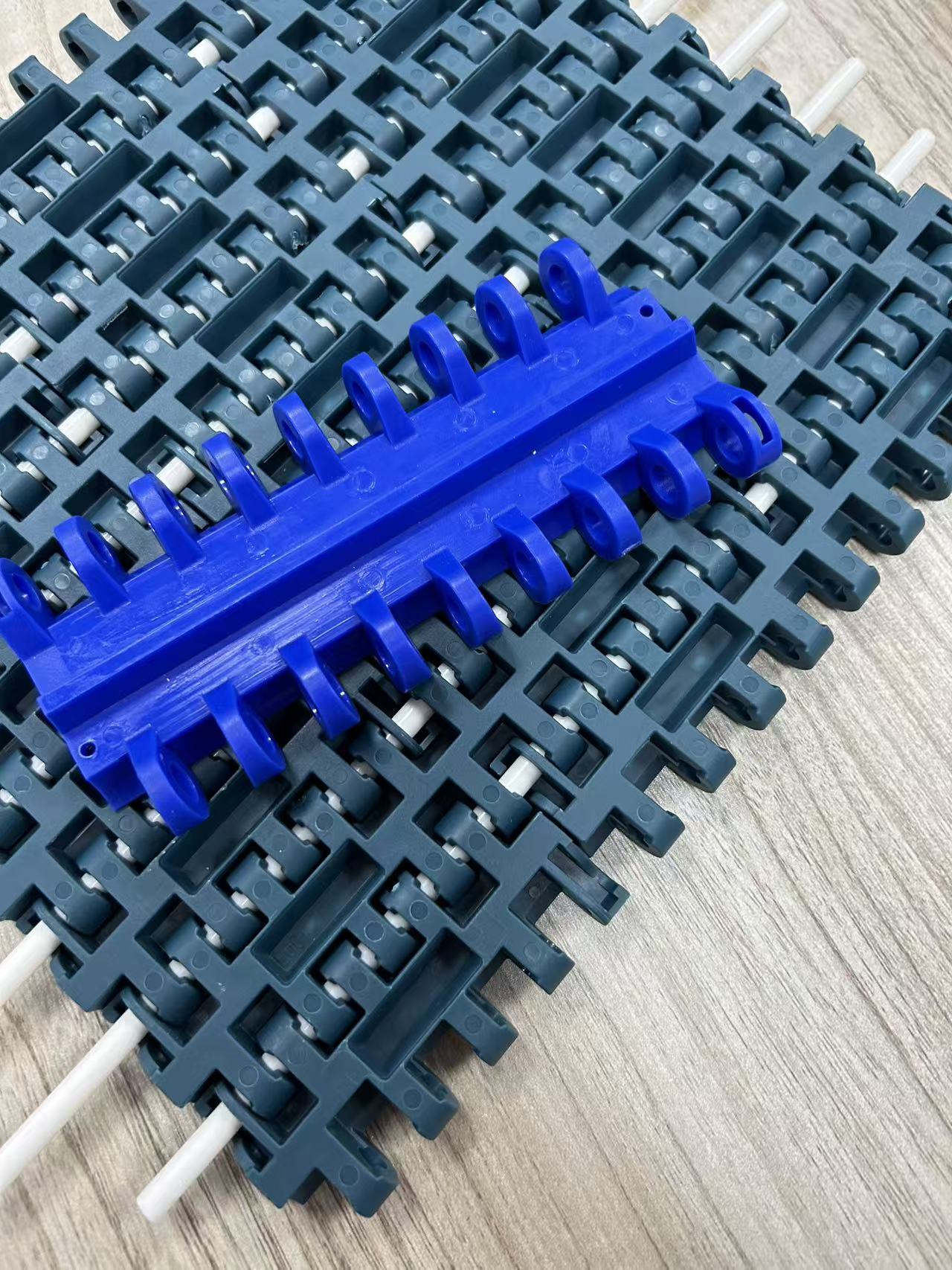
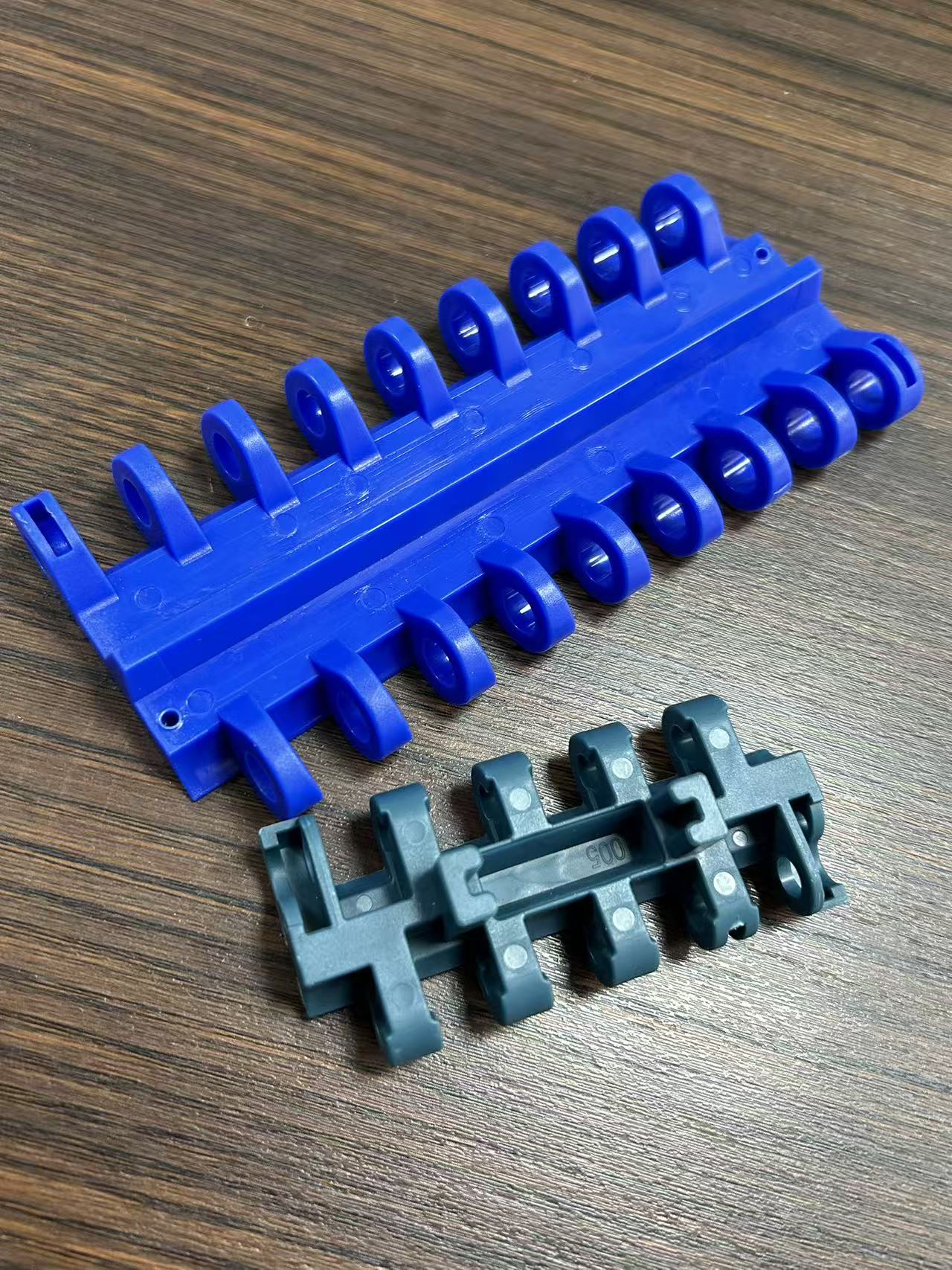
A modular mesh chain belt is built from interlocking plastic modules pinned into a continuous, open-surface chain. The construction is defined by a repeating pitch, and it can be configured with raised features — baffles, ribs, or side walls — to control product position on an incline or during accumulation.
A representative food-industry configuration is the PQ350mm±3mm modular chain belt:
- Structural configuration: flat belt surface with straight baffles
- Pitch: 25.4 mm
- Belt width: 350 mm ± 3 mm
- Material: PP/POM (PP modules with PP pins)
- Baffle width: 283.4 mm ± 3 mm
- Baffle height: 50 mm
- Baffle spacing: 153.6 mm
- Distance from baffle to both sides: 33.3 mm
- Applicable industries: food, beverage, and pharmaceutical
The straight baffles are the key hygiene-relevant feature in this configuration. They divide the belt into defined carrying pockets at a consistent 153.6 mm spacing, which keeps product from sliding back on inclines and from crowding at transfer points. The modular construction also means liquid drains through the belt rather than sitting on it — useful on lines where produce, packaged goods, or washed items are still wet when they travel.
PU flat belts: continuous surface, clean high-speed movement
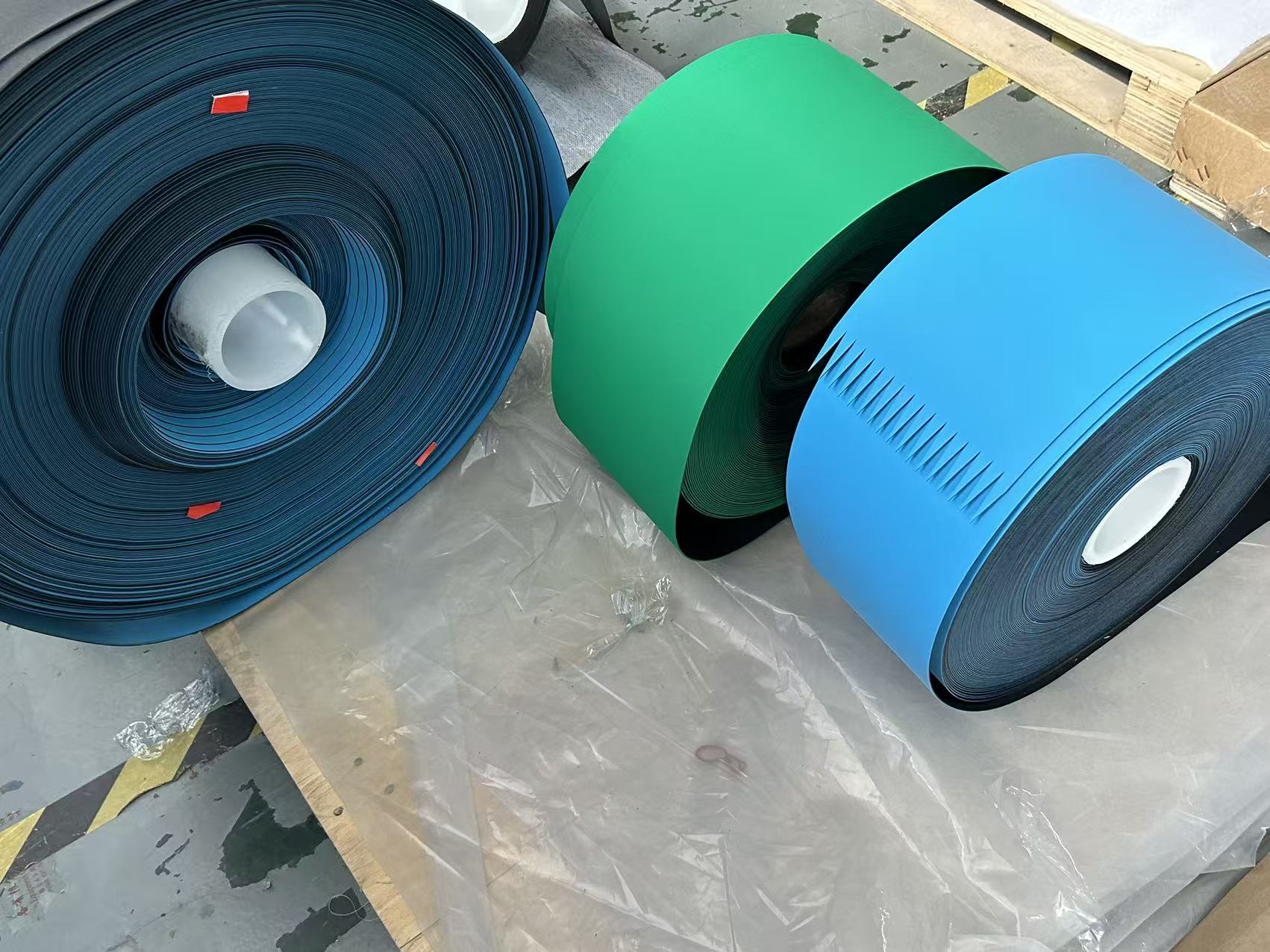
A flat belt is a continuous, closed-surface belt. Where the modular chain interrupts its surface with hinges and gaps, a flat belt presents an unbroken face. That difference matters in two situations: high-speed transport, where a smooth surface reduces vibration and tracking issues, and clean transfer, where a continuous surface is easier to wipe down between product runs.
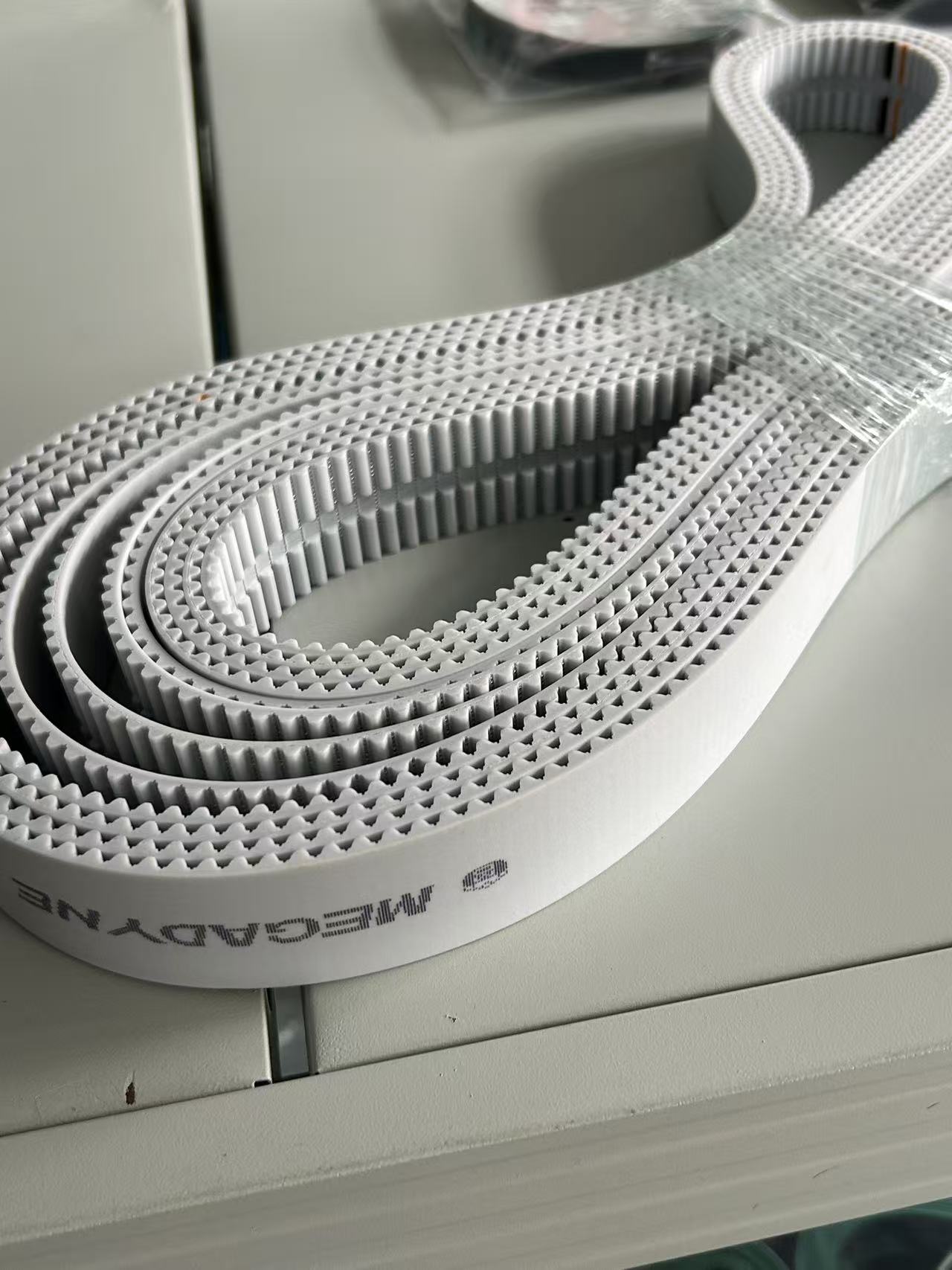
A PU flat belt is constructed from polyurethane. Representative specifications in this range include:
- Material: PU (polyurethane)
- Reference dimensions: 2482 mm length × 16 mm width
- Model designations: 2482*16; SMT-UGU-09B-J-L2210-W15; FLAT BELT HY-18-568*14 NFT-NFB
- Applicable industries: logistics, photovoltaic, and similar applications
The defined 16 mm width and 2482 mm length show that flat belts are typically specified to a machine rather than to a general conveying duty. When a line runs a single product profile at speed, a flat belt matched to that width produces less edge wear and less product skew than an over-wide belt.
The synchronous drive layer behind both belt types
Neither belt family moves on its own. Food lines that require exact speed matching between sections — filling, capping, labeling, indexing — use synchronous transmission rather than friction drive.
A timing belt in this range is made of PU and rubber, with model designations including 28HTD5M-765+NFT+NFB and S5M-20-L1650. The S5M-20-L1650 specification defines an S5M tooth shape, 20 mm width, and 1650 mm length. The belt is intended for the photovoltaic, food and beverage, pharmaceutical, and industrial manufacturing sectors.
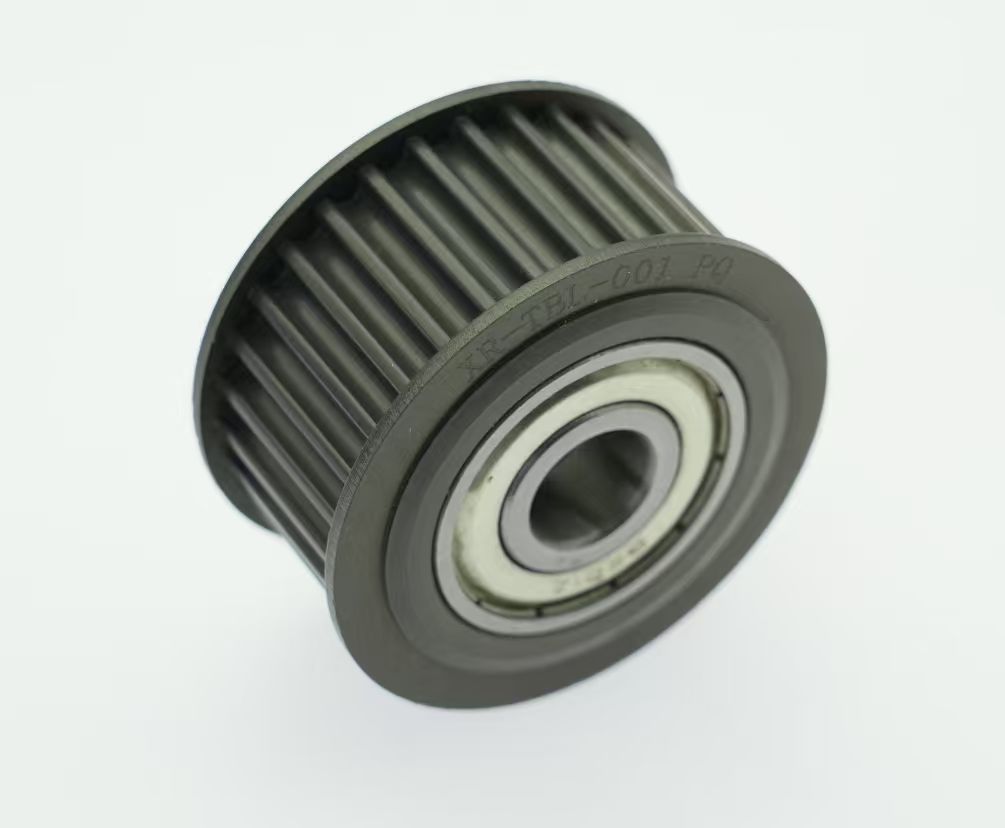
Timing belts run on matching pulleys. A synchronous wheel — also called a timing pulley — in the same range is available in models GT2 48T and GT2 14T and is constructed from aluminium and stainless steel. Structural parameters include HDB.34-14M.115F/ and Taper Bush BC6545F60. Aluminium and stainless steel are the two common pulley materials in food environments: stainless steel for washdown zones, aluminium where weight and speed matter more than corrosion resistance.
How to Match Belt Type to Hygiene Need — Step by Step
The following sequence keeps the decision tied to plant conditions instead of to belt appearance.
- Define the hygiene regime first. Write down the cleaning method (dry wipe, water rinse, chemical washdown), the frequency, and the temperature involved. A belt that is specified before this step is specified by guesswork.
- Choose surface type: open or continuous. If liquid, crumbs, or wash water needs to fall away from the product, an open modular mesh chain is the structurally appropriate choice. If the surface needs to be wiped clean between runs and must stay flat at speed, a continuous flat belt fits better.
- Check the product-handling requirement. Inclines, declines, and accumulation zones need positive product control. That is where baffled modular belts such as the PQ350mm±3mm configuration — with 50 mm baffle height and 153.6 mm baffle spacing — do work that a flat belt cannot.
- Confirm dimensions against the actual machine. Belt width and pitch are not negotiable once the frame is fixed. The modular chain belt's 25.4 mm pitch and 350 mm ± 3 mm width, or a flat belt's 2482 mm × 16 mm reference size, must match the existing pulleys, sprockets, and side rails.
- Verify the drive method. Determine whether the section is friction-driven or synchronously driven. Synchronous sections require a matched timing belt and pulley — for example an S5M-20-L1650 belt running with a GT2 48T or GT2 14T synchronous wheel.
- Document the material claim. Confirm which food-contact standard the belt is declared against, and confirm the material actually used — PP/POM modules and PP pins on the modular belt, PU on the flat belt, PU and rubber on the timing belt.
Decision rule: if the product must be held in place on an incline or drained while wet, start with a baffled modular mesh chain. If the product must travel flat, fast, and clean on a continuous surface, start with a PU flat belt. Everything else — pitch, width, baffle geometry — is then a sizing exercise.
Use Cases: Where Each Belt Fits
Wet produce and washed items. Vegetables and fruit that are still draining after washing need a belt that lets water fall through. The open modular construction and the flush-grid food and vegetable chain configuration suit this duty, while the baffles control product position on the incline out of the wash station.
Packaged and carton handling. Where cartons, trays, or wrapped goods move in a straight run at moderate speed, a modular straightrun chain with raised rib or flat top modules carries the load, and the defined pitch keeps transfer timing predictable across line sections.
Clean, high-speed transfer. Narrow PU flat belts, such as the 2482 mm × 16 mm reference size, are used where a continuous surface and low vibration are the priority — including logistics and photovoltaic handling, and other applications where a smooth face is required.
Indexing and synchronized sections. Filling, capping, labeling, and print sections that must stay in step with each other rely on timing belts and synchronous pulleys. The PU/rubber timing belt range and the GT2 and S5M pulley families support this duty in food, beverage, and pharmaceutical settings.
High-temperature zones. Some food and adjacent process environments operate at elevated temperature. Belt specification in these zones must follow the documented high-temperature capability of the selected material and construction, and the belt should be matched to the highest temperature it will actually meet in service, not to the average line temperature.
Modular Mesh Chain vs Flat Belt: Comparison Table
| Comparison point | Modular mesh chain belt (PQ350mm±3mm) | PU flat belt (2482*16 range) |
|---|---|---|
| Surface structure | Open modular modules with straight baffles | Continuous closed surface |
| Material | PP/POM (PP modules, PP pins) | PU (polyurethane) |
| Key dimensional data | Pitch 25.4 mm; width 350 mm ± 3 mm; baffle width 283.4 mm ± 3 mm; baffle height 50 mm; baffle spacing 153.6 mm; baffle-to-side distance 33.3 mm | Length 2482 mm; width 16 mm |
| Product handling | Baffles create defined carrying pockets for inclines and accumulation | Smooth face for flat, uninterrupted product travel |
| Liquid behaviour | Drainage through the open structure | Continuous surface; easier to wipe between runs |
| Applicable industries (per product data) | Food, beverage, pharmaceutical | Logistics, photovoltaic, and similar applications |
| Typical fit | Inclines, wet produce, accumulation, packaged goods | Clean, high-speed, single-profile transfer |
Where Shanghai Pengqian Fits the Supply Picture
Shanghai Pengqian Transmission Equipment Co., Ltd. is a manufacturer established in 2012 and located in Songjiang District, Shanghai, China. The company operates from a 3000m² manufacturing facility, employs approximately 60 staff, and maintains an R&D team of 8 engineers. Its product portfolio covers conveyor belts, tooth polyurethane rubber synchronous belts, synchronous wheels, rubber seamless belts, silicone belts, string welding machine belts, sintering furnace net belts, PEEK belts, sealing rings, various models of chains, and modular belts.
For food-line buyers, the relevant point is breadth of the transmission stack rather than a single belt. Export business accounts for 40% of total sales, with major markets in Europe, Asia, and the Middle East — so the food and beverage specifications discussed above are already supplied into markets that apply both FDA and EC 1935/2004 expectations.
FAQ: Matching Food Conveyor Belts to Hygiene Requirements
What hygiene and testing standards apply to food conveyor belts?
Industrial conveyor belts are tested against international standards such as ISO 283 for tensile strength and ISO 284 for electrical conductivity. Hygienic conveyor belts used in food processing are regulated by frameworks including FDA requirements and EC 1935/2004. These documents should be requested and confirmed against the specific belt and the specific contact surface — the standard applies to the product as supplied, not to the belt family in general.
Can a modular mesh chain belt and a PU flat belt run on the same food line?
Yes, and on many food lines they do. The two belt types serve different duties: the modular chain belt handles inclines, drainage, and product positioning through its baffle geometry, while the PU flat belt handles clean, continuous, high-speed transfer. Because both are supplied with defined pitch and width data — 25.4 mm pitch and 350 mm ± 3 mm width on the PQ350mm±3mm modular chain, and a 2482 mm × 16 mm reference size on the flat belt — each section can be sized independently as long as the transfer points between them are aligned. Where a section must stay synchronized with another, a timing belt such as the S5M-20-L1650 running on a matching synchronous wheel is used instead of friction drive.
What drives the cost difference between a modular chain belt and a flat belt?
Cost is driven by construction complexity and material volume rather than by belt type alone. A baffled modular chain belt such as the PQ350mm±3mm configuration carries additional moulded features — baffles at 153.6 mm spacing, a 283.4 mm ± 3 mm baffle width, and a 50 mm baffle height — plus the pins that join the modules, so it uses more material and more tooling than a plain flat belt. A PU flat belt of 2482 mm × 16 mm has a simpler continuous construction. Buyers comparing quotations should compare total belt length, width, baffle count, pin quantity, and material grade, not the belt type name.
How do buyers validate a belt before committing to full production?
Validation normally follows the same order as the selection steps: confirm the hygiene regime, confirm surface type, confirm dimensions against the machine, then confirm material documentation. The practical checkpoints are whether the belt's pitch and width match the existing sprockets, pulleys, and rails, and whether the declared material and standard documentation match the food safety plan. Where the line has specific drainage, incline, or temperature conditions, these should be stated at the inquiry stage so that belt construction and material are matched to the actual duty rather than to a generic specification.
What lead time should be expected for a food-grade belt configuration?
Lead time depends on whether the specification matches an existing model or requires a custom configuration. Standard model designations — such as the PQ350mm±3mm modular chain belt, the PU flat belt models 2482*16 and SMT-UGU-09B-J-L2210-W15, the timing belts 28HTD5M-765+NFT+NFB and S5M-20-L1650, and the synchronous wheels GT2 48T and GT2 14T — move through a shorter path than a bespoke width, baffle spacing, or material combination. Because Shanghai Pengqian manufactures its own belt range rather than only reselling, custom requirements are handled at the factory level. To confirm current lead time for a specific food-line belt, send the machine dimensions, belt width, pitch, and cleaning regime to the team at www.shanghai-pengqian.com or by email at abbypeng@pengqian.cn.
Conclusion
Matching a conveyor belt to food-industry hygiene needs is a structural decision, not a price decision. Modular mesh chain belts and PU flat belts solve different problems: the modular chain, in a baffled configuration such as PQ350mm±3mm with 25.4 mm pitch and 50 mm baffles at 153.6 mm spacing, handles product positioning, drainage, and incline duty in food, beverage, and pharmaceutical lines. The PU flat belt, in defined sizes such as 2482 mm × 16 mm, handles clean, continuous, high-speed transfer. Where a line needs exact speed matching, a PU and rubber timing belt such as S5M-20-L1650 running on an aluminium or stainless steel synchronous wheel keeps the sections in step.
The order matters: define the cleaning regime, choose the surface type, then size the belt to the machine. Buyers who work in that order specify once and avoid the rework that comes from a belt that cleans well but cannot hold product — or holds product but cannot be cleaned.
Next Step: Match a Belt to Your Food Line
If you are specifying a belt for a food, beverage, or pharmaceutical line, the fastest way to a precise answer is to share the machine dimensions, belt width, pitch, cleaning method, and operating temperature. Shanghai Pengqian Transmission Equipment Co., Ltd. manufactures modular belts, flat belts, timing belts, and synchronous wheels from its facility in Songjiang District, Shanghai, and supplies markets across Europe, Asia, and the Middle East.
Request a sample or quotation, or download the product brochure for full model data:
Website: www.shanghai-pengqian.com
Email: abbypeng@pengqian.cn
Tel: +86 177-0218-9858
WhatsApp: +86 173-5663-6871
Brochure: Download the Shanghai Pengqian product brochure (PDF)
Have Questions or Need More Details?
Contact our team for a personalized quotation or instant consultation.
Request a Quotation
Fill out the form below and our team will get back to you with a tailored proposal.
WhatsApp Direct Chat
Prefer to chat in real-time? Message us on WhatsApp for instant assistance & quick answers.
- Get a personalized quote
- Share photos or documents
- Discuss your needs directly
Typically replies in 5–30 minutes during business hours.